Cash stuffing, without the paper envelopes
The cash stuffing method works because every dollar gets a job on payday and every envelope has a hard limit. Neither of those requires cash. Here's how to run the whole thing on your iPhone — and where the paper version still wins.
- Cash stuffing = envelope budgeting. On payday you split your take-home pay into labelled envelopes and spend only from the right one. Empty envelope, no more spending in that category.
- The cash is the prop, not the method. Assigning every dollar on payday and having a visible hard limit are what make it work — a digital envelope app does both, and also covers rent, subscriptions and online orders.
- Start with about six envelopes, take bills off the top first, add one sinking fund for irregular costs, and log purchases within a few seconds of tapping your card.
- Paper still wins if you specifically need the friction of handing over notes to stop yourself. That's a real reason — we say so below.
# What the cash stuffing method actually is
Cash stuffing went viral on TikTok as a ritual: a binder, a stack of labelled sleeves, and someone counting twenties into "Groceries" and "Fun money" on payday. The aesthetic is new. The method underneath is a century old, and it's plain envelope budgeting:
- Your pay lands.
- You divide all of it into named envelopes, until nothing is left unassigned.
- You spend from the envelope that matches the purchase.
- When an envelope is empty, that category is done until next payday.
That's the whole system. It works for a reason most budgeting advice misses: it moves the decision from the moment you're tempted to the calm moment on payday. By the time you're standing in a shop, the thinking is already done — you just check whether there's anything in the envelope.
The reason people quit isn't usually discipline. It's that the paper version is a hassle to keep up in a world where rent, Netflix and half your groceries leave your account without ever passing through your hands.
# Why people move it to their phone
Somewhere around week three, most paper stuffers hit the same four walls:
- Half your spending never touches cash. Rent, insurance, subscriptions, anything online. So the binder only ever covers part of your money, and the important part goes untracked.
- You have to visit an ATM every payday and split it into exact denominations. Miss one week and the habit breaks.
- You're carrying your whole month's budget in a binder. Lose it, and it's gone — there's no undo on cash.
- Nobody can see it but you. If you budget with a partner, one physical binder in one house is a coordination problem.
Moving to a digital envelope app fixes those four without touching the part that works. You still assign every dollar on payday. You still spend against a named envelope with a hard limit. You just stop carrying the money around.
| Paper cash stuffing | Digital envelopes | |
|---|---|---|
| Every dollar gets a job | Yes | Yes |
| Hard limit you can see | Yes — the sleeve is empty | Yes — the envelope drains |
| Covers card & online spending | No | Yes |
| Covers rent & direct debits | Awkward | Yes — as bills |
| Payday setup time | ATM trip + counting | Seconds |
| If you lose it | Money's gone | Backed up |
| Two people, two locations | No | Yes |
| Physical friction when spending | Strong | Weaker — you must log it |
| Ongoing cost | Binder + sleeves | Free tier, or ~$20/yr |
The one row where paper genuinely wins is the second-to-last. More on that below.
# How to do it on your iPhone, step by step
Set aside twenty minutes for the first run. After that, each payday takes under a minute.
- Start from take-home pay, not salary Use what actually lands in your account each payday — after tax, super or 401(k), and anything your employer already deducts. Then set your pay schedule: weekly, every two weeks, twice a month or monthly. Everything else keys off this rhythm.
- Take your bills off the top List every bill due before your next payday — rent, power, phone, insurance, subscriptions — and set that money aside first. Bills are not envelopes; that money is already spoken for. This single step is what stops the "I had money last week, where did it go" spiral.
- Name about six envelopes One per thing you genuinely spend on week to week. A normal starting set: groceries, gas, eating out, household, fun money, and one personal category (pets, hobbies, kids). Resist fifteen — every extra envelope turns each purchase into a filing decision, and that's what makes people quit.
- Fund each envelope from real history, not hope Scroll back through two or three months of bank statements and total what you actually spent per category. Use that number, not the aspirational one. A groceries envelope set $80 too low doesn't make you spend less; it makes you abandon the budget.
- Add a sinking fund for the irregular stuff Christmas, a car service, the annual insurance bill, a trip. Pick the amount and the date, and put a slice aside every payday. This is the piece paper stuffers most often skip — and it's why a $600 car service feels like an emergency instead of a Tuesday.
- Do your stuffing day On payday, fill everything in one sitting until nothing is left unassigned. Do it the day the money lands, before anything gets spent. Making this a small ritual — same moment, same order, three minutes — is more predictive of sticking with it than any spreadsheet skill.
- Log each purchase within a few seconds Tap your card, then log the spend against its envelope while you're still walking out. The whole method depends on your envelope balances being true; a day-old memory of what you spent is not true. If logging takes more than a few seconds in your app of choice, you will stop doing it — this is the single most important thing to test before you commit.
Everything above is standard advice you'll find anywhere. Step 7 is the one that separates people who are still budgeting in March from people who aren't. Time it: from your phone on the table to a logged purchase should be a handful of seconds, not a form.
# A worked example: $2,000 every two weeks
Abstract advice is easy to nod at and hard to copy. Here's one full stuffing day for someone taking home $2,000 every two weeks.
| Where it goes | Detail | Amount |
|---|---|---|
| Bills | Rent $800 · power $55 · phone $40 · car insurance $95 · subscriptions $60 | $1,050 |
| Sinking funds | Christmas $60 · car service $60 · trip $30 | $150 |
| Groceries | Weekly shop for two | $340 |
| Gas | Two tanks | $90 |
| Eating out | The envelope that hurts | $120 |
| Household | Cleaning, repairs, the random stuff | $60 |
| Fun money | No justification required | $80 |
| Pets | Food and the vet fund | $50 |
| Unassigned | Deliberate slack — the buffer | $60 |
| Total | Nothing left over, by design | $2,000 |
Three things worth copying from this example. First, bills came off the top — the $740 in envelopes is real spending money, not a number that quietly owes rent. Second, there are six envelopes, not fifteen. Third, $60 is left unassigned on purpose: a buffer absorbs the parking fine and the birthday you forgot, so one surprise doesn't knock the whole plan over.
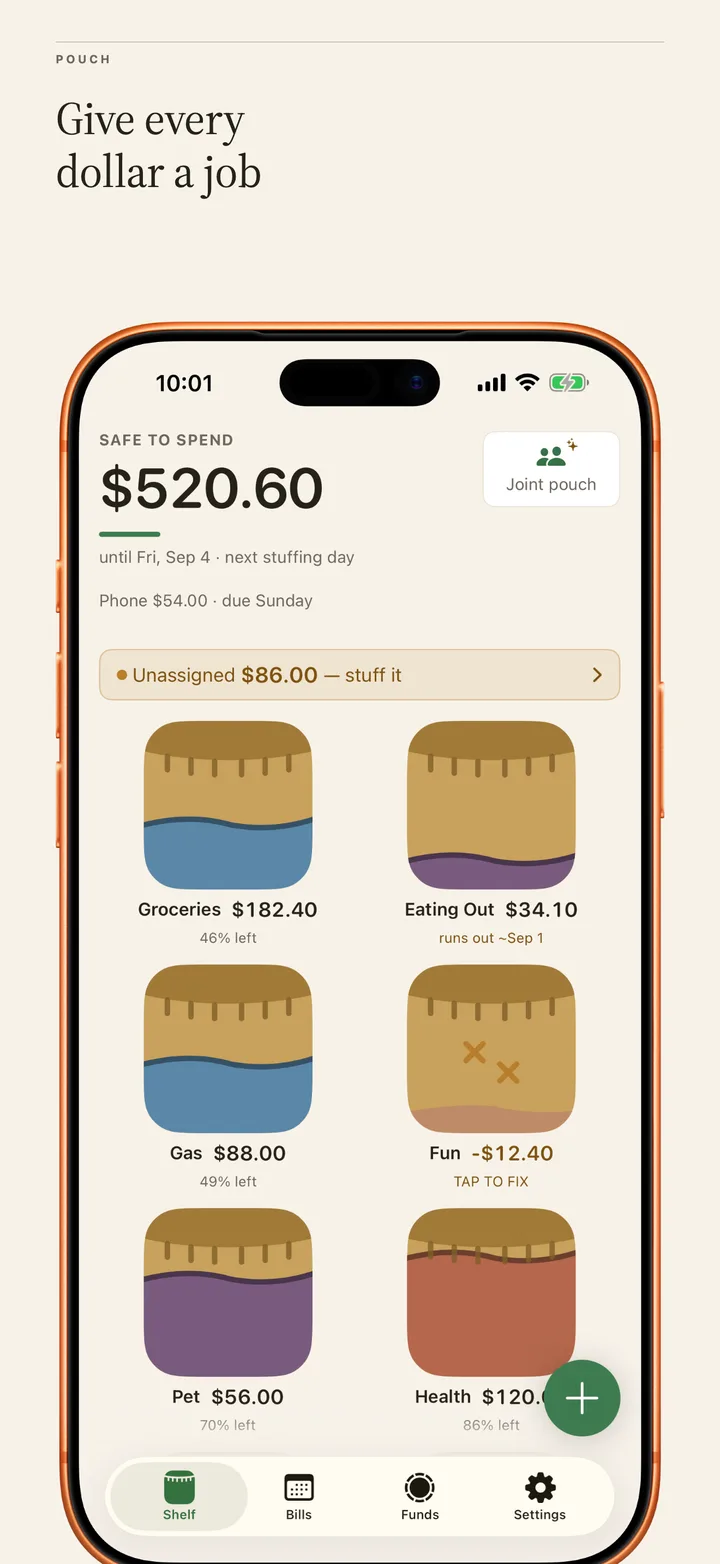
The number to watch afterwards isn't any single envelope — it's your safe to spend: what's genuinely left until your next paycheck once bills are accounted for. That's the one figure worth checking daily.
# When an envelope runs out early
It will, and that isn't failure — it's the system doing its job. You have three honest options:
- Move money from another envelope and accept the trade. Fun money covers the grocery overshoot; you've made a real decision instead of a vague one.
- Take it from unassigned, if you left yourself a buffer. That's exactly what the buffer is for.
- Stop spending in that category until payday. Uncomfortable, occasionally the right call, and the reason the method works at all.
What you must not do is let an envelope sit quietly overspent. The moment your balances stop being true, they stop being useful, and you're back to guessing. Good envelope apps make this loud rather than letting a negative number hide — Pouch shows an overspent envelope in the open with a one-tap fix, because a budget you're avoiding looking at has already stopped working.
One diagnostic: if the same envelope runs dry three paydays running, it isn't a discipline problem, it's an underfunded envelope. Change the plan, not the month.
# Sinking funds: the part most stuffers skip
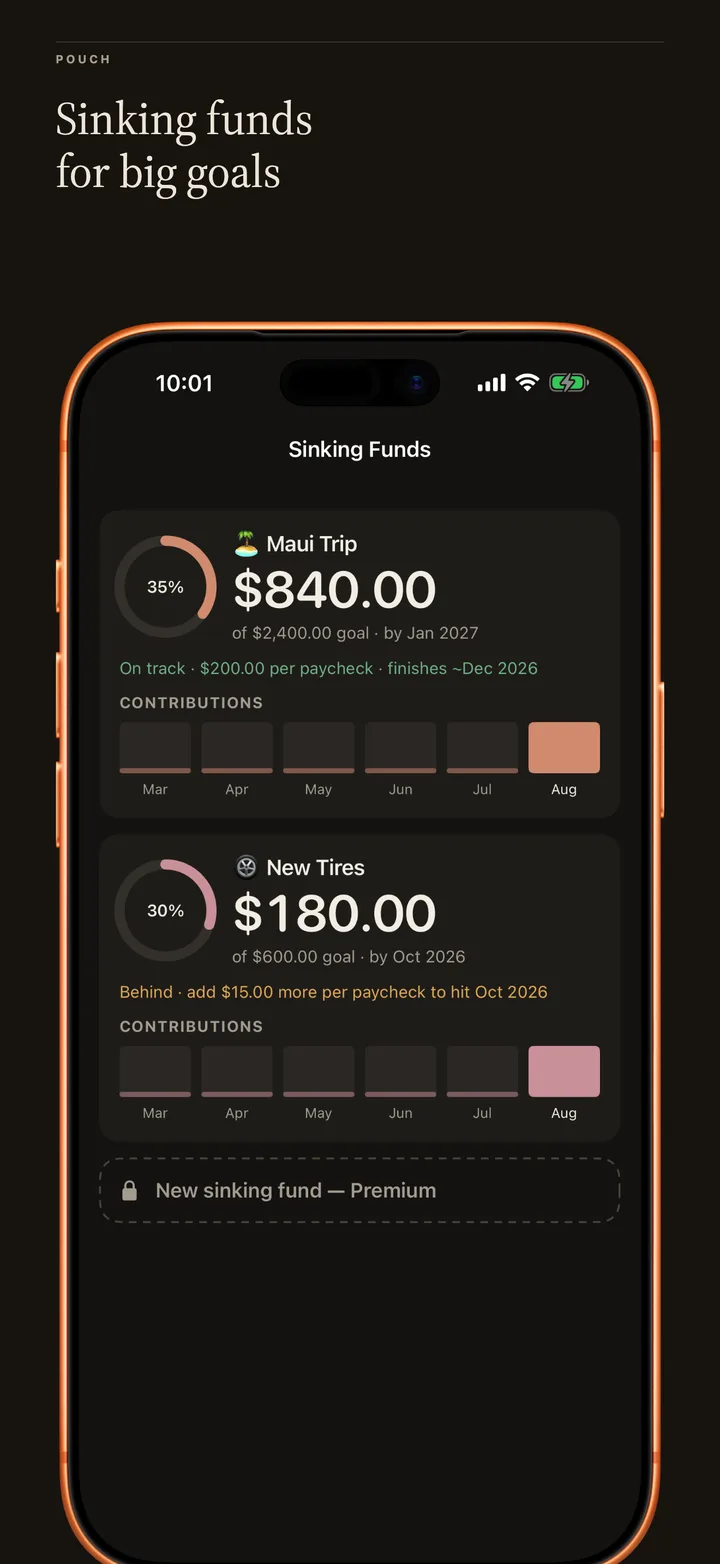
Paper cash stuffing handles weekly spending beautifully and irregular spending terribly. Nobody keeps $600 in a sleeve for eleven months waiting for a car service.
A sinking fund is the fix: a target amount, a date, and a small slice put aside every payday. $60 every two weeks from September buys you a $600 service in April with no drama and no credit card. Registration, Christmas, the annual insurance premium, replacing a laptop, a trip — all of them are predictable, and all of them ambush people who only budget one payday at a time.
Set two or three and the entire emotional texture of your budget changes: big bills stop being events.
# The honest part: when paper still wins
Digital envelopes lose one thing, and it's not a small thing. Handing over physical notes hurts, and that friction is doing real work. Tapping a card and logging it afterwards is frictionless by comparison — the limit is still there, but your hand doesn't feel it.
So stick with the binder, or run a hybrid, if:
- You've tried digital budgeting before and the honest problem was that tapping didn't feel like spending.
- You're in a period of active overspending and need a hard physical stop, not a number.
- The ritual itself — the counting, the sleeves — is what keeps you engaged. That's a legitimate reason, and it's most of why cash stuffing went viral in the first place.
A hybrid works well and is what a lot of people land on: run everything digitally, but pull actual cash for the one or two categories you genuinely overspend — usually eating out and fun money. You get full coverage of rent and subscriptions, plus physical friction exactly where you need it.
# What to look for in a cash stuffing app
Most apps in the "budget" category are category trackers: they connect to your bank, sort last month's spending into pie charts, and tell you what you already did. That is not envelope budgeting, and it won't give you the thing that makes cash stuffing work. A real envelope app should:
- Make you assign money on payday — a stuffing ritual, not a report.
- Show a live balance per envelope, not a percentage of a monthly category.
- Log a purchase in seconds, from the Home Screen or a widget. Test this before anything else.
- Handle bills separately from envelopes, with due dates.
- Have sinking funds with real target dates.
- Not require your bank login. Manual entry is the feature here: it's the ten seconds of attention that keeps you connected to your own money — and nothing to breach.
Pouch was built for precisely this method on iPhone: a stuffing day that takes about fifteen seconds, a safe to spend number at the top of the shelf, three-tap logging (two from the widget), bills with a calendar, and sinking funds paced to a date. No accounts, no bank linking, no analytics — your budget lives on your iPhone. The free tier is genuinely usable forever: 6 envelopes, a sinking fund, a widget and 12 months of history. Unlimited envelopes, more funds, iCloud sync and a shared pouch with your partner are $19.99/yr, or $49.99 once for life.
Coming from another app? Our honest Goodbudget alternative guide compares the options, including where Goodbudget still beats us.
# Frequently asked questions
What is the cash stuffing method?
Cash stuffing is envelope budgeting: on payday you divide your take-home pay into labelled envelopes — groceries, gas, fun money — and only spend from the matching envelope. When it's empty, you stop spending in that category until next payday. TikTok made the paper version famous; the method itself is decades old.
Can you do cash stuffing without cash?
Yes. The cash is the prop, not the method. What makes it work is assigning every dollar a job on payday and having a visible hard limit — a digital envelope app does both, and also covers rent, subscriptions and online orders that never pass through your hands.
What's the best cash stuffing app for iPhone?
Look for a true envelope app rather than a category tracker: it should make you assign money on payday, show a live per-envelope balance, and work without your bank login. Pouch is built for exactly that — stuffing day, safe to spend, sinking funds and widgets, free for 6 envelopes and $19.99/yr for unlimited.
How many envelopes should I start with?
About six — one per thing you genuinely spend on week to week. Fifteen envelopes looks thorough and collapses within a month, because every purchase becomes a filing decision.
What happens when an envelope runs out before payday?
Move money from another envelope and accept the trade, or stop spending in that category. Both are the system working. The one thing to avoid is leaving an envelope quietly overspent — the moment your balances stop being true, they stop being useful. If the same envelope runs dry three paydays running, it's underfunded: fix the plan, not the month.
Does cash stuffing work if my income is irregular?
Better than most methods, because you only ever stuff money you actually have. Budget from the paycheck that just landed instead of a forecast: cover bills due before your next likely payday, fund the essential envelopes, and leave the rest unassigned as a buffer rather than spreading it thin.
Is cash stuffing the same as the 50/30/20 rule?
No. 50/30/20 is a target for how your money splits across needs, wants and savings. Cash stuffing is the mechanism that makes any split actually happen day to day. You can run 50/30/20 percentages inside your envelopes — but the envelopes are what stop the overspending.
Cash stuffing, minus the cash
Pouch brings the envelope method to iPhone — stuffing day, safe to spend, sinking funds and widgets. No accounts, no bank linking, free to start.
Download on the App Storefree to start · iPhone · iOS 17+